Controllers
Each different hardware object is directly controlled by a software object called controller. This object is responsible for mapping the communication between a set of hardware objects (example: motors) and the underlying hardware (example: a motor controller crate). The controller object is also exposed as a Tango device.
Controllers exist to keep Sardana hardware independent: the elements offer stable, generic interfaces (move, count, read, …) on which scans, macros and GUIs are built, while the controller plug-in translates those generic operations into the dialect of a particular piece of hardware. To support new hardware only a new controller class has to be written; nothing else in the system needs to change.
Usually a controller is capable of handling several hardware objects. For example, a motor controller crate is capable of controlling several motors (generally called axis [1]).
The controller objects can be created/deleted/renamed dynamically in a running pool.
A specific type of controller needs to be created to handle each specific type of hardware. Therefore, to each type of hardware controller there must be associated a specific controller software component. You can write a specific controller software component (plug-in) that is able to communicate with the specific hardware. You can this way extend the initial pool capabilities to talk to all kinds of different hardware.
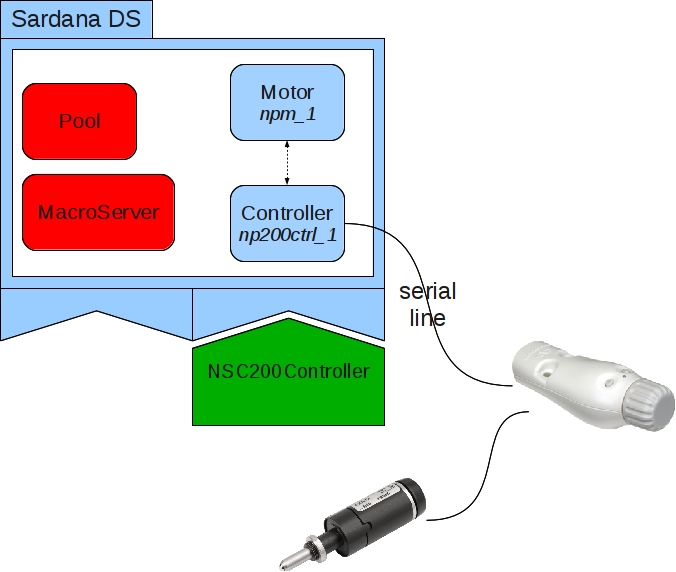
A diagram representing a sardana server with a controller class NSC200Controller, an instance of that controller np200ctrl_1 “connected” to a real hardware and a single motor npm_1.
Controller-element relation
A sardana controller is responsible for its sardana element(s). Example: an IcePAP hardware motor controller can control up to 128 individual motor axes. In the same way, the corresponding software motor controller IcepapController will own the individual motor axes.
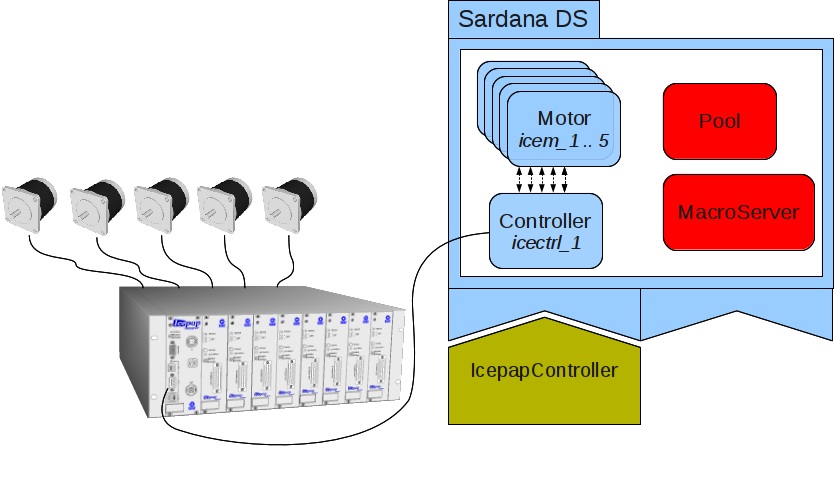
A diagram representing a sardana server with a controller class IcepapController, an instance of that controller icectrl_1 “connected” to a real hardware and motors icem_[1..5].
Controller types
These are the different types of controllers recognized by sardana:
MotorControllerYou should use/write a
MotorControllersardana plug-in if the device you want to control has a moveable interface. TheMotorControlleractually fulfills a changeable interface. This means that, for example, a power supply that has a current which you want to ramp could also be implemented as aMotorController.Example: the Newport NSC200 motor controller
CounterTimerControllerThis controller type is designed to control a device capable of counting scalar values (and, optionally, have a timer).
Example: The National Instruments 6602 8-Channel Counter/Timer
ZeroDControllerThis controller type is designed to control a device capable of supplying scalar values. The API provides a way to obtain a value over a certain acquisition time through different algorithms (sum, average, integral).
Example: an electrometer
OneDControllerThis controller type is designed to control a device capable of supplying 1D values. It has a very similar API to
CounterTimerController.Example: an MCA
TwoDControllerThis controller type is designed to control a device capable of supplying 2D values. It has a very similar API to
CounterTimerController.Example: a CCD
TriggerGateControllerA controller designed to control synchronization devices (digital trigger and/or gate generators) used to synchronize the acquisition of experimental channels (see Synchronization).
PseudoMotorControllerA controller designed to export virtual motors that represent a new view over the actual physical motors.
Example: A slit pseudo motor controller provides gap and offset virtual motors over the physical blades
PseudoCounterControllerA controller designed to export virtual counters that represent a new view over the actual physical counters/0Ds.
IORegisterControllerA controller designed to control hardware registers.
Controllers as plug-ins
Controller plug-ins can be written in Python. Each controller code is
basically a Python class that needs to obey a specific API: it
declares its properties, attributes and custom commands as class members (from
which the configuration interface is generated automatically) and implements the
methods of its controller type (e.g. for a motor controller: StateOne,
ReadOne, StartOne, AbortOne, …). Here is an extract of a
Python motor controller able to talk to a Newport NSC200 motor controller:
from sardana.pool.controller import MotorController, \
    Type, Description, DefaultValue

class NSC200Controller(MotorController):
    """This class is the Tango Sardana motor controller for the Newport
    NewStep handheld motion controller NSC200."""

    ctrl_properties = \
        { 'SerialCh' : { Type : str,
                         Description : 'Communication channel name for the serial line' },
          'SwitchBox': { Type : bool,
                         Description : 'Using SwitchBox',
                         DefaultValue : False},
          'ControllerNumber' : { Type : int,
                                 Description : 'Controller number',
                                 DefaultValue : 1 } }

    def StateOne(self, axis):
        status = int(self._queryCommand("TS"))
        status = self._STATE_MAP.get(status, State.Unknown)
        ...
        return status, "OK", switchstate

    def ReadOne(self, axis):
        return float(self._queryCommand("TP"))

    def StartOne(self, axis, pos):
        self._setCommand("PA", pos)

    def AbortOne(self, axis):
        self._setCommand("ST", "")
Besides values, a controller may also expose actions — calibrating an axis, resetting a counter — as custom commands. These become Tango commands on the element and controller devices, next to the standard ones.
Plug-in discovery
Controller classes are not registered anywhere by hand. The Pool discovers
them by scanning the directories listed in its PoolPath Tango device
property: every Python module found there is inspected and the controller
classes it defines become available for instantiation. Creating a controller
instance then only requires giving the class name, an instance name and
values for the declared controller properties. This makes the set of
supported hardware a deployment time decision rather than a build time one.
See also
- Writing controllers
How to write controller plug-ins in sardana
- Controller API reference
the controller API
Controllerthe controller tango device API
Footnotes